


Artificial Intelligence (AI)
Projects & Industry Impact
Our Work in this Domain
Circular Innovation Lab is beginning a new programme of research and policy engagement on artificial intelligence and the circular economy. As a research and policy think tank, our focus is on generating the evidence base, policy frameworks, and strategic insights needed to ensure that the rapid global expansion of AI advances, rather than undermines, the circular economy transition. Our emerging work examines the lifecycle footprint of AI across critical raw materials, semiconductor manufacturing, and hyperscale data centres, and explores how circular principles can be embedded into the design, deployment, and end-of-life management of AI hardware. In parallel, we are investigating how AI can be harnessed to accelerate circularity across our focus sectors of textiles, electronics, food, plastics, and construction, through applications such as material traceability, digital product passports, AI-driven sorting and reverse logistics, predictive maintenance, and generative design for circular materials. A central thread of our work is policy, analysing how emerging frameworks such as the EU AI Act, the Ecodesign for Sustainable Products Regulation, and global initiatives on sustainable AI can be aligned with circular economy objectives, with particular attention to the implications for emerging economies, just transition pathways, and the governance of critical raw materials.
Training a single large AI model can emit as much CO₂ as five cars over their entire lifetimes, and global data centres are projected to consume more electricity than Japan by 2026.
Artificial intelligence is rapidly becoming a foundational infrastructure of the global economy, with sweeping implications for material flows, energy systems, and the circular economy transition. The AI market is projected to reach USD 1.8 trillion by 2030, growing at a CAGR of over 36%. While AI offers powerful tools to accelerate circularity across sectors, the AI ecosystem itself carries a significant and rapidly expanding environmental footprint across its full value chain, from raw material extraction to data centre operation to hardware disposal. Addressing this footprint through circular design is essential.

Raw Materials
The hardware that powers artificial intelligence depends on a complex and resource-intensive supply chain of critical raw materials. Advanced semiconductors, GPUs, and AI accelerators require gallium, germanium, cobalt, lithium, copper, and a range of rare earth elements, many of which are concentrated in geopolitically sensitive regions. The International Energy Agency projects that demand for these critical minerals will more than double by 2030, driven in large part by digital infrastructure and AI hardware. Extraction is associated with significant environmental and social impacts, including habitat loss, water pollution, and labour rights concerns, particularly in artisanal mining contexts.

Manufacturing and Hardware Production
The fabrication of advanced semiconductors is one of the most resource-intensive industrial processes in the world. Producing a single 300mm silicon wafer requires more than 8,000 litres of ultrapure water and significant quantities of energy, specialty gases, and chemicals. As AI workloads drive demand for ever more powerful chips, the manufacturing footprint of the sector continues to grow rapidly. Embodied emissions from hardware production now represent a substantial share of the total lifecycle impact of AI systems, and supply chain concentration in a small number of countries raises additional resilience concerns.
Data Centres and Model Training
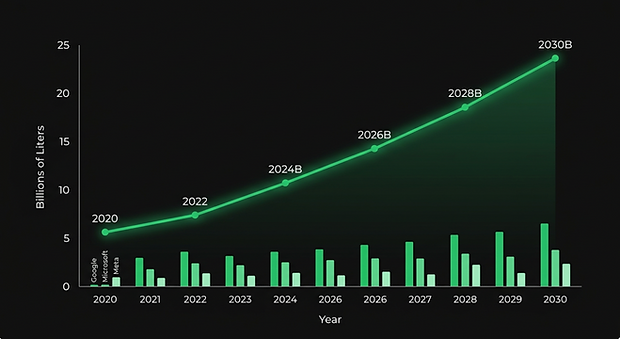
Operational impacts arise primarily from the data centres that host AI training and inference workloads. Training large foundation models can consume megawatt-hours of electricity and millions of litres of freshwater for cooling. The International Energy Agency estimates that global data centre electricity consumption could reach over 1,000 TWh by 2026, roughly doubling from 2022 levels, with AI being a primary driver. Water withdrawals for hyperscale data centres are increasingly contested in water-stressed regions, raising urgent questions about siting, cooling technologies, and renewable energy integration.

Deployment and Use
Inference, the everyday use of AI models by billions of users, is now estimated to account for the majority of AI's operational footprint, exceeding the impact of training itself. The energy intensity of a single AI query can be ten times that of a conventional internet search. At the same time, AI is increasingly being deployed to support circularity by optimising recycling and sorting systems, enabling digital product passports, extending product lifecycles through predictive maintenance, and accelerating circular materials discovery through generative design. The net impact of AI on the circular economy depends critically on how, where, and for what purpose it is deployed.


End-of-life
The accelerating refresh cycles of AI hardware are contributing to one of the world's fastest-growing waste streams. Global e-waste reached 62 million tonnes in 2022 and is projected to rise to 82 million tonnes by 2030, with only 22% currently collected and recycled formally. Servers, GPUs, and networking equipment contain valuable recoverable materials, including gold, silver, palladium, and rare earth elements, yet most are landfilled, incinerated, or exported informally. Designing AI hardware for disassembly, refurbishment, and material recovery, and developing robust secondary markets, will be essential to closing the loop on the AI value chain.
